
How to Budget for a Summer Vacation
Summer is almost here. And with it comes that exciting but slightly scary question: Can we actually afford this trip?
You’re not alone in asking that. In 2026, travel costs have jumped significantly — airfares alone are up nearly 15% compared to last year, and everyday costs like food and entertainment at tourist spots have gone up too. Many families are rethinking their vacation plans, and some are skipping trips altogether.
But here’s the thing — you don’t have to choose between a great summer and a healthy bank account. With the right plan, you can have both.
This guide will walk you through exactly how to budget for a summer vacation, step by step, without stress or regret when you get home.
Why So Many People End Up Broke After Vacation
Before we get into tips, let’s talk about why vacations blow budgets in the first place.
Most people only plan for the “big” costs — flights and hotels. They forget about:
- Airport parking
- Checked baggage fees
- Tipping
- Overpriced resort food
- Souvenirs and impulse buys
- Travel insurance
- Rental car extras
These “small” things can easily add 20–30% to your total trip cost. If you didn’t plan for them, that money comes from somewhere — usually a credit card.
The fix? Build a complete vacation budget before you book anything.

Step 1: Set Your Total Vacation Budget First
This is the most important step, and most people skip it.
Before you pick a destination, decide how much you can realistically spend on this trip — total. Not “how much is the flight” — the whole thing.
Here’s a simple way to figure that out:
- Look at your monthly income after bills and necessities
- Decide how many months you have to save
- Multiply your monthly savings amount by those months
Example: You have 4 months to save, and you can set aside $600/month. That gives you a $2,400 vacation budget.
Now build your trip around that number — not the other way around.

Step 2: Break Down Every Cost Category
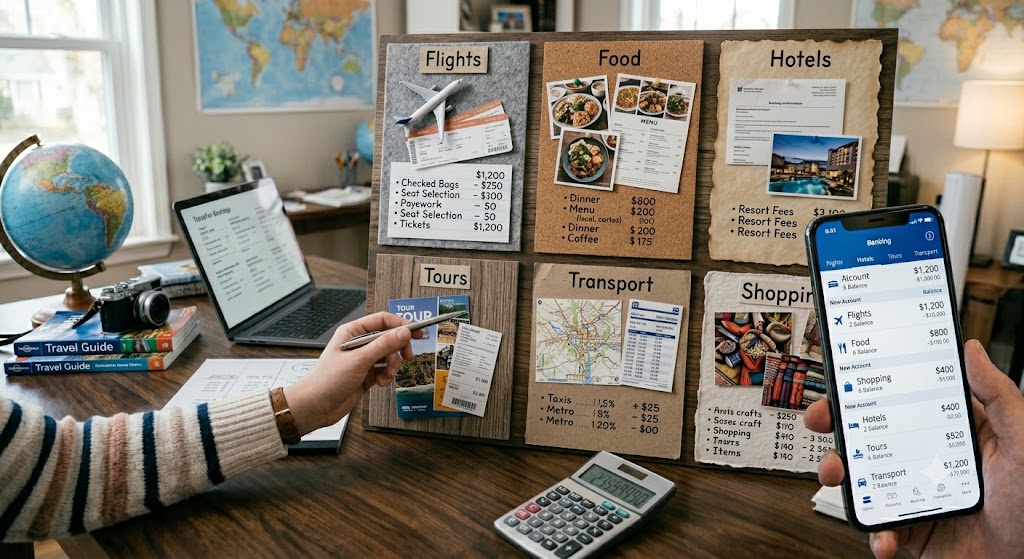
Once you have a total number, split it across all the real costs of travel. Here’s a smart breakdown for a 7-day family vacation:
| Category | Percentage of Budget |
|---|---|
| Flights or Transportation | 30–40% |
| Accommodation | 25–30% |
| Food & Dining | 15–20% |
| Activities & Entertainment | 10–15% |
| Emergency Buffer | 10–15% |
That last one — the emergency buffer — is non-negotiable. Unexpected costs will happen. Budget for them in advance so they don’t ruin your trip.
Step 3: Choose Your Destination Based on Budget, Not Dreams
There’s no shame in picking a destination that fits your wallet. In fact, it’s the smarter move.
In 2026, many families are choosing:
- Road trips over flying (saves significantly on transportation)
- Nearby states or regions over far international destinations
- Off-season or shoulder-season travel (August or September can be cheaper than peak June/July)
- Less-touristy spots that offer the same beauty for less money
A weekend at a state park, a road trip along the coast, or a visit to a smaller city can be just as memorable as an expensive resort — and a lot less stressful on your finances.
Pro tip: Use Google Flights to compare prices across different dates and airports. Being flexible by even 2–3 days can save you hundreds.

Step 4: Save for Your Trip the Smart Way
Once you know your goal, make saving automatic.
Open a separate savings account just for your vacation. Label it with the trip name if your bank allows it — something like “Summer Beach Trip 2026.” This small psychological trick makes it feel real and helps you avoid dipping into it for other things.
Then set up an automatic transfer on every payday. Even $50 or $100 per paycheck adds up quickly.
In 2026, high-yield savings accounts are offering 4–5% APY. If you’re saving $2,000–$3,000 over several months, the interest actually adds a little extra to your fund.
Other ways to boost your vacation fund:
- Put your tax refund straight into the travel account
- Sell things you don’t need on Facebook Marketplace or eBay
- Pick up a side gig for a month or two
- Cut one subscription you barely use for a few months

Step 5: Book Smart — Timing Is Everything
When and how you book makes a massive difference to your final cost.
For flights:
- Book domestic flights 6–8 weeks in advance
- Book international flights 3–6 months in advance
- Set up price alerts on Google Flights or Hopper
- Fly on Tuesday, Wednesday, or Saturday — these are usually cheaper days
- Avoid checking bags — carry-on only saves you $30–$60 each way per person
For hotels and accommodation:
- Compare hotels, Airbnb, and VRBO — for groups or longer stays, home rentals often win on price
- Look for free breakfast included — it eliminates one full meal per day
- Book rooms with a mini fridge or kitchenette to store snacks and leftovers
- Check if the hotel has free parking before you book (resort fees are a hidden cost)
For rental cars:
- Book early and compare multiple sites (Kayak, Expedia, and direct rental sites)
- Decline add-ons you don’t need at the counter — they add up fast

Step 6: Cut Food Costs Without Killing the Fun
Food is one of the biggest budget-busters on vacation. Eating every meal at a restaurant adds up to hundreds of dollars per person over a week.
Here’s how to eat well without overspending:
- Eat a big breakfast at your hotel or room to reduce mid-day hunger
- Pack snacks for travel days — airport food is notoriously overpriced
- Shop at a local grocery store the day you arrive for basics (drinks, breakfast items, easy lunches)
- Eat out for one meal a day, not three — make it the experience, not the routine
- Look for lunch specials at restaurants — many offer the same menu at lower prices than dinner
- Search for “kids eat free” nights if you’re traveling with children
One grocery run can save your family $50–$100 per day. That money can go toward a really memorable activity instead.

Step 7: Find Free and Low-Cost Activities
You don’t need to spend a fortune to have an amazing time. Most destinations have plenty of free or cheap things to do.
Before you go:
- Check the city or destination’s official tourism website for free events
- Look for free outdoor concerts, festivals, or cultural events during your travel dates
- See if any museums offer free admission on certain days
At the destination:
- National parks are one of the best values in travel — a $80 America the Beautiful annual pass gets your family into over 2,000 federal recreation areas
- Many beaches, hiking trails, and scenic spots are completely free
- Walking neighborhoods, local markets, and waterfront areas cost nothing
The best memories from a trip are rarely the expensive ones. A hike, a sunset, a local festival — these are the moments people actually remember.

Step 8: Use Credit Card Rewards (If You Have Them)
If you have a travel rewards credit card, this is the time to use those points.
Nearly a third of 2026 summer travelers plan to use credit card points or miles to cover travel expenses. Hotels and flights are the best redemptions.
A few smart tips:
- Don’t open a new card just for a trip unless you have months to accumulate points
- Check if your card offers travel insurance — it might mean you don’t need to buy separate insurance
- Pay off the card immediately after each purchase so you’re not paying interest
If you don’t have rewards cards, that’s fine — the other strategies above will do the job.

Step 9: Track Your Spending During the Trip
A budget only works if you actually follow it on the road.
“Vacation mode” is real. Everything seems like a reasonable purchase when you’re relaxed and having fun. The $15 souvenir, the upgrade, the fancy dinner — it all adds up.
Simple ways to stay on track:
- Before the trip, write down your daily spending limit (total budget ÷ number of days)
- Check in every evening to see where you are
- Use a free budget app like Mint or a simple notes app to log expenses
- Bring a set amount of cash for discretionary spending — when it’s gone, it’s gone

Step 10: Have an Emergency Fund Separate From Your Trip Budget
This is different from the buffer inside your vacation budget.
Your vacation buffer covers expected unknowns — extra food, a small activity you didn’t plan. Your emergency fund is for the real stuff: a medical situation, a missed flight, a car breakdown on a road trip.
Before you leave, make sure you have at least $300–$500 accessible that is NOT part of your planned vacation spending. You may never need it — but you’ll be so glad it’s there if you do.

What a Realistic 2026 Summer Vacation Budget Looks Like
Here’s a sample budget for a family of 4 taking a 7-day road trip:
| Item | Estimated Cost |
|---|---|
| Gas (round trip, ~600 miles) | $120 |
| Accommodation (6 nights) | $700 |
| Food (mix of cooking + dining out) | $500 |
| Activities & entrance fees | $200 |
| Snacks, souvenirs, misc | $150 |
| Emergency buffer | $200 |
| Total | $1,870 |
A $2,000 budget. Completely doable with 4 months of saving $500/month.
Now compare that to what an unplanned trip could look like: last-minute flights, full hotel breakfasts, dining out every meal, expensive tourist activities — and you could be looking at $5,000+ and coming home with a credit card bill.
Planning makes that difference.
Final Thoughts
A summer vacation doesn’t have to leave you financially stressed for months afterward. The key is to start planning early, set a real budget, and make decisions that match what you can actually afford.
The most memorable trips aren’t always the most expensive ones. They’re the ones where you felt free — not worried about money the whole time.
So set your budget, pick your destination, and start saving today. Your summer trip is closer than you think, and it doesn’t have to cost you your financial peace.
Read More :$50 Weekly Meal Plan for a Family of Four (With Grocery List)