
No Spend Challenge
There’s a moment most people have had. You check your bank account, do some mental math, and wonder where all the money went. You weren’t being reckless. You didn’t make any big purchases. But somehow, another month passed and the savings barely moved.
That’s exactly what a no spend challenge is designed to fix.
It’s not about deprivation. It’s not about living on rice and water for 30 days. It’s about pressing pause on automatic, mindless spending — and using that pause to figure out where your money is actually going.
In 2026, with prices up across the board and “buy now, pay later” options making it easier than ever to spend without thinking, a monthly spending reset isn’t just a fun challenge. For a lot of people, it’s genuinely necessary.
This guide covers everything: what the challenge actually is, the rules, a week-by-week game plan, how to handle the hard moments, and what to do when the 30 days are done.
What Is a No Spend Challenge?
A no spend challenge — sometimes called a no-buy month or spending freeze — is a commitment to stop spending money on non-essential items for a set period of time. Usually 30 days.
Here’s what “no spending” actually means:
You still pay for essentials:
- Rent or mortgage
- Utilities and internet
- Groceries (within a budget)
- Transportation (gas, public transit)
- Medications and healthcare
- Minimum debt payments
You pause all non-essentials:
- Eating out, coffee shops, takeout
- Clothing, shoes, accessories
- Online shopping
- Entertainment (movies, concerts, subscriptions you can pause)
- Home decor, gadgets, impulse buys
- Beauty and personal care extras (beyond basics)
That’s it. Simple in concept. Genuinely challenging in practice — which is exactly what makes it work.
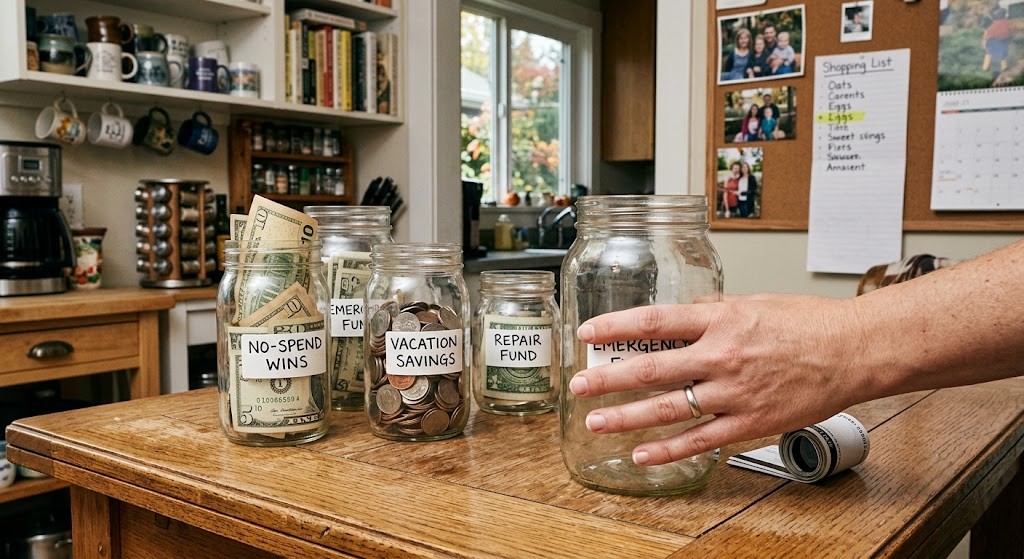
Why Do a No Spend Challenge?
The financial benefits are obvious — you save money by not spending it. But the real value of a no spend month goes deeper than that.
1. You discover your spending triggers. You’ll quickly notice why you spend. Boredom? Stress? Social pressure? A well-placed email from your favorite store? That awareness is worth more than the money saved.
2. You break the habit loop. Impulse spending is largely habitual. You see it, you buy it, you feel a brief hit of satisfaction, you repeat. A 30-day freeze interrupts that loop long enough for your brain to rewire it.
3. You find out how much you actually need. Most people dramatically overestimate how much they “need” to spend. After 30 days of essentials-only, you’ll have a much more realistic picture of your actual monthly needs.
4. You save a meaningful amount. The average American spends hundreds of dollars per month on discretionary items. Even a partial reset — cutting restaurant spending, pausing subscriptions, stopping impulse buys — can save $300–$800 in a single month.

Before You Start: Set Up for Success
The biggest reason people abandon a no spend challenge in week two isn’t willpower. It’s poor preparation. Here’s what to do before Day 1:
Define Your Rules Clearly
Write down exactly what counts as “allowed” and what doesn’t. Be specific. Vague rules lead to rationalizations.
For example:
- Allowed: Grocery runs up to $X per week, gas, bills, medications
- Not allowed: Restaurants, coffee shops, online shopping, new clothing, apps, subscriptions
Decide in advance what to do with edge cases. Birthday gift for a friend? Decide now, not in the moment when you’re already in the store.
Choose the Right Month
Timing matters. Avoid months with major events — a milestone birthday, a holiday, a planned vacation. You’re setting yourself up to fail if the month is stacked against you.
Many people choose January (post-holiday reset), May, or September. Pick a month with a clear calendar and stick to it.
Set a Goal That Motivates You
Why are you doing this? “To save money” is too vague.
Better goals:
- “I want to save $500 toward my emergency fund”
- “I want to pay off my credit card balance”
- “I want to save for a trip this fall”
- “I want to understand where my money goes”
Write your goal down. Put it somewhere you’ll see it when you’re tempted to spend.
Do a Pre-Challenge Grocery Shop
Stock your fridge and pantry with enough food to get through the first week without needing a big shop right away. Include some easy freezer meals for the nights when you have zero energy and are tempted to order delivery.
Remove Temptation
- Delete shopping apps from your phone
- Unsubscribe from retailer email lists (or use the Unsubscribe button — it takes 30 seconds)
- Remove saved payment information from your browser
- Unfollow accounts on social media that make you want to buy things
You’re not testing your willpower. You’re removing the situations where willpower would need to be tested.

Week 1 (Days 1–7): The Honeymoon Phase
Week one usually feels exciting. You’re motivated. You’re checking your bank balance and feeling good. This is the easiest week.
What to focus on:
- Track every dollar you don’t spend. Seriously — every time you would have ordered lunch or grabbed a coffee, write down what it would have cost. Watching that number grow is motivating.
- Plan your meals for the week before grocery shopping. Stick to the list.
- Identify your first “trigger moment.” The afternoon snack run? The late-night Amazon scroll? When does it happen? Now you know.
Tips for week one:
- Tell someone close to you what you’re doing. Accountability makes a real difference.
- Find one free activity to replace something you’d normally pay for — a walk, a library visit, a home movie night.

Week 2 (Days 8–14): The Grind
Week two is where most people stumble. The novelty has worn off. Life is still happening — a friend invites you to dinner, a good sale lands in your inbox, you’re stressed and your normal coping mechanism (buying something) is off the table.
What to focus on:
- Remember your goal. Come back to it. Write it out again if you need to.
- Eat from your pantry and freezer before grocery shopping. You likely have more food than you think.
- Find social alternatives. If friends want to get together, suggest a potluck, a walk, a movie night at someone’s house. Most people are more flexible than you assume.
Tips for week two:
- Use the “write it down” trick. When you want to buy something, write it down in a list. Tell yourself you can buy it after the 30 days if you still want it. (You usually won’t.)
- One slip-up does not mean failure. If you spend $4 on a coffee on a hard Tuesday, that’s not a reason to quit. It’s a reason to keep going.

Week 3 (Days 15–21): Finding Your Rhythm
By week three, something shifts. The discomfort starts to fade. New habits are forming. You’re cooking at home automatically. You’re not reaching for your phone to scroll shopping apps.
What to focus on:
- Review where you are financially. How much have you saved so far? Calculate it. Move whatever you’ve saved into a savings account so it’s real and visible.
- Start thinking about what you want your financial life to look like after the challenge. This is a good time to plan a simple monthly budget based on what you’ve learned.
- Take stock of your pantry again. You may be surprised how much you still have.
Tips for week three:
- Explore free activities in your area — parks, libraries, community events, local trails. Many people discover free entertainment they didn’t know existed.
- If boredom is a trigger, fill that time with something intentional: a skill you want to learn, a home project, a book you’ve been meaning to read.

Week 4 (Days 22–30): The Home Stretch
You can see the finish line. Don’t start rationalizing exceptions just because you’re close. The last week is about finishing strong — and starting to plan what comes next.
What to focus on:
- Do a full review of what you’ve spent this month. Compare it to your average month. The difference is your savings — and also a clear picture of what you were spending on autopilot before.
- Make a list of the things you wrote down that you “wanted to buy.” Which ones do you still want? Which ones have you already forgotten? That list tells you a lot about your relationship with spending.
- Set up a post-challenge spending plan so you don’t binge-spend the moment the month ends.
Tips for week four:
- Don’t wait until Day 30 to move your savings somewhere safe. Move it now.
- If you want to keep going — keep going. Some people find that 30 days isn’t enough to break deep habits, and they extend to 60 or 90 days for specific categories.

“My friends want to go out.”
Be honest with them. “I’m doing a no spend month — can we do something free instead?” True friends will respect it. You might even inspire them. If you can’t get out of an event, offer to bring a dish, pay only for what you brought, or commit to a drink of water.
“It’s someone’s birthday.”
Plan for this in advance. Make something instead of buying it. Bake a cake. Write a heartfelt card. Give a gift from what you already have. Time and effort mean more than a store-bought gift anyway.
“I have an unexpected expense.”
True emergencies are allowed. A broken appliance that’s genuinely needed, a medical expense, a car repair — life happens. Handle it. Then keep going. This is not a reason to abandon the whole challenge.
A craving for takeout because it’s been a long day is not an emergency. Learn to feel the difference.
“I’m bored.”
This is the most common breaking point. Stock up on free options in advance:
- A list of free activities (walks, YouTube, library, a free museum day)
- Books you’ve been meaning to read
- A project you’ve been putting off
- A skill you want to learn (free YouTube tutorials exist for basically everything)
Boredom passes. And often what feels like boredom is actually the withdrawal from the dopamine hit of buying something new.

What to Do After the 30 Days
Finishing is great. But the real benefit comes from what you do next.
Don’t binge spend. The most common mistake after a no-spend month is treating Day 31 like a shopping holiday. You worked 30 days to break habits — don’t undo it in 48 hours.
Build a real budget. You now have 30 days of real spending data. Use it. Build a monthly budget based on what you actually need, not what you used to spend automatically.
Keep one habit from the challenge. Meal planning. Cooking at home. Canceling unused subscriptions. Pick at least one thing that worked during the challenge and make it permanent.
Move your savings somewhere intentional. If you saved $400 during the challenge, don’t let it sit in your checking account where it will slowly disappear. Put it toward your emergency fund, debt, or savings goal.
Consider a monthly “no spend week.” You don’t have to do a full month every time. Many people who complete a no-spend month adopt one no-spend week per month as a permanent habit. It keeps spending awareness alive all year.
How Much Can You Actually Save?
It depends on your starting spending habits — but here are realistic estimates for someone who cuts non-essentials for 30 days:
| Category Paused | Estimated Monthly Savings |
|---|---|
| Restaurants and takeout | $150–$300 |
| Coffee shops | $40–$80 |
| Online shopping / impulse buys | $100–$250 |
| Clothing and accessories | $50–$150 |
| Entertainment and subscriptions | $30–$80 |
| Total potential savings | $370–$860 |
That’s one month. Put that money toward debt or savings, and the impact compounds.
Final Thoughts
A 30-day no spend challenge is not about punishing yourself. It’s about hitting pause on habits that formed without you really deciding to form them.
Thirty days is short enough to be doable and long enough to be genuinely transformative. By the end, you’ll spend differently — not because you forced yourself, but because you’ve seen clearly what your spending was actually doing (and not doing) for you.
Pick your month. Write your rules. Tell someone. Start Day 1.
Your future self — and your bank account — will thank you.
Read More : How to Create a Monthly Budget That Actually Works (2026 Guide)